


Vrnik: The Small Island That Helped Build the World
A short paddle from Lumbarda, across water so clear you can watch your own shadow glide over the seabed, sits one of the most quietly extraordinary islands in the Adriatic. Vrnik doesn’t announce itself – no ferry terminal, no crowds, just a scattering of stone houses and the last few residents who still call it home. But for centuries, this tiny island shaped skylines an ocean away. We bring guests here on several of our tours, and we never get tired of watching their faces when they realize what they’re standing on.
While researching this, two things stood out to me the most: a Roman-era stone plaque that was mistranslated for over a century, and the underground quarries dug entirely by hand. I’ll go into both in more detail below.
This isn’t the first time I’ve dug into Vrnik’s quarries. Back in 2015, my colleague Vinka Marinković and I researched and presented a paper on the Lumbarda archipelago’s quarries at an ASMOSIA conference; much of what’s below is built on that same research, updated and told for a general audience rather than a room of conservators. If that is something of your interest, you can check it here: ASMOSIA POSTER 2015. It has more pictures from different islands in the archipelago, not just Vrnik.
The Island That Built the World
Vrnik is the second-largest island in Korčula’s Škoji archipelago, and the only one of that small cluster that’s permanently inhabited. What makes it remarkable isn’t its size – it’s what lies beneath it. Vrnik holds the oldest and most celebrated stone quarry in the entire Korčula region, with 29 individual quarries cut into the island over the centuries, still privately owned today by Vrnik and Lumbarda families. Their sheer rock faces, some rising 40 meters, are the island’s single biggest visual draw. Centuries of quarry waste, piled up over generations, formed a landscape of their own, low hills now overgrown with cypress and laurel, tall enough in places to half-hide the quarries beneath them.
The stone itself has a reach that’s hard to believe for a place this small. There’s evidence the Roman emperor Diocletian used Vrnik limestone in his palace in Split. By the 14th century, the stone was already being shipped to Dubrovnik and Ston, and later to Šibenik, Zadar, and as far as Ancona on Italy’s coast. In 1482, Juraj Dalmatinac, the architect behind Šibenik Cathedral, now a UNESCO World Heritage Site came to Korčula in person to select stone for the build. From there, Vrnik’s limestone quietly made its way into some of the world’s most recognized landmarks: the Hungarian Parliament Building in Budapest, and, closer to home, a long list of Dubrovnik’s defining buildings: the Rector’s Palace, the Divona customs house, the city clock tower, St. Blaise’s Church, the Dominican church, the monasteries of Male Braće, St. Marija, and St. Klara, buildings on the island of Lokrum, and the mirror-smooth paving of the Stradun itself.
Long before the surface quarries you can walk today were cut, Vrnik’s earliest stoneworking happened underground. The layer of poor-quality rock sitting above the good stone ran 1 to 3 meters thick, too costly to strip away with the tools of the time, so quarrymen tunneled straight into the healthy stone vein instead, leaving the surface layer untouched. It’s a method known as selective quarrying, and the resulting chambers, roughly 3 meters high, made Vrnik home to one of the oldest quarrying traditions. Similar underground galleries can be visited today on our Sutvara Island nearby, but have also been found elsewhere in the Mediterranean and beyond: in Germany, Tunisia, Catalonia, and Bosnia and Herzegovina. According to the medieval chronicler Toma Arhiđakon, Roman authorities sent Christians condemned during the persecutions to labor in these underground quarries as a substitute for execution.
At its peak, up to 600 stonemasons worked these quarries. The tradition eventually produced some of Croatia’s most celebrated sculptors, including Frano Kršinić and the Lozica brothers, and it’s said that stonemasons from Vrnik even traveled to the island of Brač to teach locals there how to quarry, a craft that then became Brač’s own claim to fame.
By the mid-20th century, dynamite had sped up extraction, though the workforce had already shrunk to roughly 200 stonemasons. Commercial extraction finally wound down in the 1960s, and the quarries fell silent. What’s left today is something rarer than an active industry: an intact, walkable record of centuries of handwork, still visible in the fishbone-patterned chisel marks cut into the rock face.
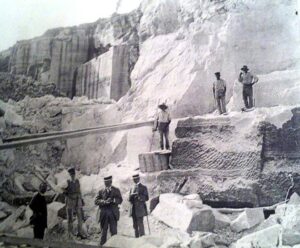
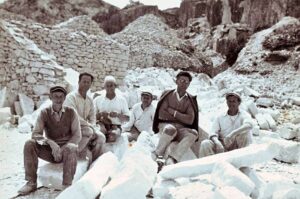
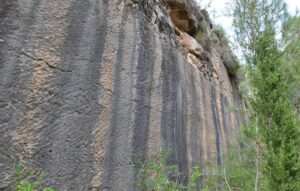
Old photos from Vrnik quarries and marks from chisels in one of the Vrnik quarries
A Village Born From Stone
Vrnik’s history reaches back further than the quarries alone suggest. A stone tablet found on the island in 1886, now kept in the Korčula town museum, is inscribed in Latin naming a man called Valentinianus and his wife Sabbatia. For decades it was believed to record ownership of a fish pond on the island, a charming but mistaken reading of the Latin word “piscinam” by the 19th-century teacher who first transcribed it. Archaeologists later corrected the record: the tablet is actually a 4th-century funerary monument, a table-shaped marker once placed over the couple’s grave as part of an early Christian burial tradition that originated in nearby Salona. Mistranslation aside, it’s still one of the earliest written traces of the island’s history, predating the permanent village by well over a thousand years.
Before Vrnik had permanent residents in the modern sense, the stonemasons who worked its quarries commuted daily by boat from Korčula town, Lumbarda, and Žrnovo, sometimes staying overnight in workshops on the island during busy stretches. It wasn’t until the 17th century that families began settling permanently, building the row of solid stone houses that still defines the village today.
The oldest structure on the island is Kaštil, a 15th-century Gothic-Renaissance building on Vrnik’s southeastern side, originally built as a summer residence for the Gabrielis-Ismaeli family, Korčula nobility whose palaces still stand in Korčula’s old town; it was fully restored a few years ago. The village’s population has fallen sharply over time: from 86 residents two centuries ago, to 173 fifty years later, to 55 as recently as four decades ago. Today, only two people live on Vrnik year-round; even the island’s last stonemason eventually gave up wintering there, worn down by the isolation and the wind. Even so, the village itself, its stone facades weathered by centuries of salt air, remains almost entirely intact.
The Old School Still Standing
Near the island’s coast sits Vrnik’s old school, built in the 19th century for the children of the quarrymen and their families. Its role changed once the quarries closed and the school-age population declined, and today the building serves a different purpose: during the summer months, it hosts exhibitions, a restaurant, and a preserved old schoolroom. Just beside it stands the church of Our Lady of Succour, built in 1856. While an older church of the same name, dating to 1674, sits on the island’s northern coast in front of one of the original quarries.
In recent years, students from Petar Šegedin Secondary School in Korčula have worked on a heritage project called “Written in Stone,” interviewing remaining Vrnik residents and documenting the island’s customs, dialect, and quarrying techniques before that living memory fades. It’s a reminder that Vrnik’s history isn’t sealed in the past tense; it’s still actively being preserved by the people who care about it most.
A Living Tradition: The Feast of Gospa od Škoja
Once a year, on July 2nd, Vrnik marks its biggest date on the calendar: the feast of Gospa od Škoja (Our Lady of the Island), the island’s patron, celebrated for more than a hundred years. A statue and reliquary are carried in procession to the island’s chapel, and on the eve of the feast, children jump over bonfires fueled by dried immortelle (smilje), the wild, resinous flower that grows across Vrnik and gives the island its distinctive scent in high summer. It’s one of the few days of the year the island fills with the kind of gathering it once knew every day, back when hundreds of stonemasons worked its quarries.
How Our Tours Bring You to Vrnik:
Vrnik isn’t a place you stumble onto by accident, which is exactly why we built it into our kayaking routes. Each of our tours that stops here gives you a different piece of the island — the quarries, the old village, and the school — always on foot, always at a pace that gives the place room to breathe.
Bits of History Whole-Day Kayak Tour
Our full-day route gives Vrnik the most time of any tour we run. We paddle out from Lumbarda, land on the island, and walk through the old quarries themselves, tracing the same chisel marks left by stonemasons generations ago, before continuing into the village and past the old school.
Bits of History Half-Day Kayak Tour
For guests with less time, our half-day version still brings you ashore on Vrnik for a guided walk through the quarries and village, condensed but never rushed.
Sunset Kayak Tour
In the golden hour before dusk, we stop at Vrnik as part of our sunset route, walking the quarry paths and village lanes in softer light, before returning to the water as the island fades into silhouette behind us.
On all three, Boris walks through limestone quarries and with the same details he’s shared with guests for years.
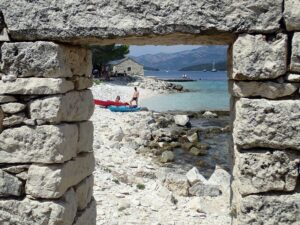
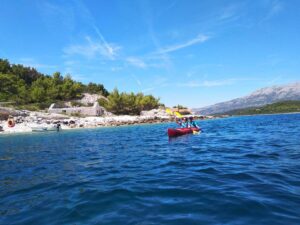
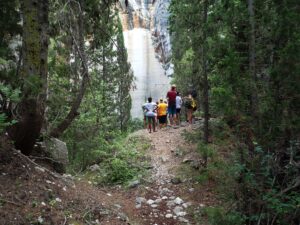
Few photos from Vrnik during our tours
Frequently Asked Questions:
What is Vrnik island known for?
Vrnik is known for its historic limestone quarries, considered the oldest and most celebrated in the Korčula region. Its stone was used in landmarks including Hagia Sophia, the White House, and Budapest’s Parliament Building.
How do you get to Vrnik island?
Vrnik is reached by boats from Korčula island – Korčula town or Lumbarda. We bring guests there by sea kayak as part of our Bits of History and Sunset kayak tours departing from Lumbarda.
Is Vrnik island still inhabited?
Yes, though barely. Only two people live on Vrnik year-round today, down from 173 residents a century and a half ago and 55 as recently as four decades ago, a steep decline from the quarry’s peak, when up to 600 stonemasons worked there.
Can you visit the old quarries on Vrnik?
Yes, the old quarries are walkable and visible today, including chisel marks left by stonemasons. They’re included on foot as part of our Bits of History and Sunset kayak tours.
Which Spirit of Korkyra tours visit Vrnik?
Vrnik is included on our Bits of History Whole-Day Kayak Tour, Bits of History Half-Day Kayak Tour, and Sunset Kayak Tour, each with a guided stop at the quarries, old village, and school.
